



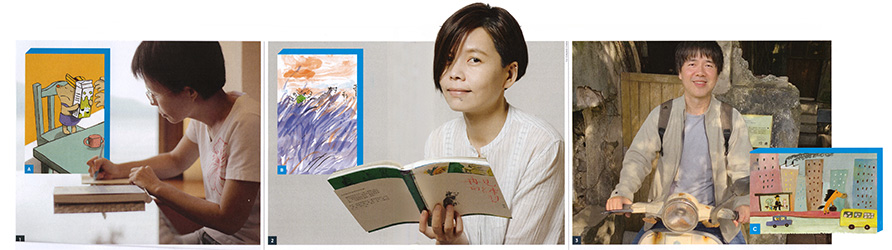
Liu has now been published into nine languages, with his most recent book in English, Little Monk Writes Rain (translated by Rachel Wang Yung-Hsin), released just ahead of this Bologna by Michigan-based Eerdmans in a clever format that unfolds vertically. Liu is also no stranger to international prizes: his trophy case includes the 2019 Silver Star of Sweden's Peter Pan Prize for Are You My Brother?.
Lynn, meanwhile, has been published in eight languages, with particular success in the Spanish markets. As an illustrator she has collaborated on other Taiwanese global hits, including Julia Liu's Leilong the brontosaurus titles.
And while Chou's standalone picture books are feted at home and abroad - The Story of Grandma Snowflower has been a particular hit with prize juries - the Mimi series is that rare commodity that works just as well as IP (it has been licensed in 14 languages and has been adapted into an animated series) and a deep, universal character study.
It is also interesting that many international editors at this Bologna have been talking about the need for humorous, playful titles that 'spark joy'. But ones that can also weave in serious, weighty topics - death, hardship, mental health issues - amid the smiles. And the work of all three of Taiwan's ALMA contenders, in their own ways, falls neatly in this space, bang on 2026's biggest trend.
Liu 的作品目前已譯成九種語言;他最近一本英文版《Little Monk Writes Rain》(Rachel Wang Yung-Hsin 譯)在本屆波隆那書展前夕,由美國密西根州的 Eerdmans 推出,並採用巧妙的直向展開形式。Liu 也早已不是國際獎項的新面孔:他的獎項紀錄中,包括 2019 年瑞典彼得潘獎銀星獎,得獎作為《Are You My Brother?》。
至於 Lynn,作品已出版八種語言版本,尤其在西語市場表現亮眼。身為插畫家,她也曾參與其他走向世界的台灣作品,包括 Julia Liu 的《Leilong the brontosaurus》系列。
而 Chou 除了單本圖畫書在國內外皆受肯定——《The Story of Grandma Snowflower》尤其深受評審青睞——《Mimi》系列更是少見地同時兼具 IP 潛力與深刻、普世角色書寫的作品(目前已授權 14 種語言,並改編為動畫系列)。
另一個值得注意的現象是,今年波隆那現場許多國際編輯都在談:市場需要能「帶來喜悅火花」的幽默、好玩的作品;但這些作品同時也必須能在笑聲之中編織死亡、困境與心理健康等沉重議題。而這三位台灣 ALMA 入圍者的作品,都以各自方式精準落在這個區間,可說正踩中 2026 年最重要的出版趨勢。
Mamma Mimi, here we go again
Chou will be familiar to many in the aisles of the Fiere. She is not only a bestselling author with more than one million units sold globally but also the founder and editor-in-chief of Taipei-based picture-books publisher Heryin, which she launched in 1998 following her return to Taiwan after living in the US.
Both Heryin and the Mimi series are rooted in Chou's educational psychology background and her 'particular passion for writing and editing'. Chou says: 'I found that picture books with carefully chosen words were especially well-suited to me. I could painstakingly refine every single word and every single image, almost to the point of obsession. [Picture books] combine both literary and visual aesthetics, becoming the place where everything I do best comes together.'
The first Mimi outing, Mimi Says No, was not conceived on a whim, as Chou used her doctoral research on humour and children to inform the content. She also wanted the series to tell stories without being didactic, and that the range would be 'books that children would genuinely enjoy. I thought that if I could write works that were truly attuned to young children's inner worlds, viewed through the lens of developmental psychology, they would probably meet real needs in early childhood'.
Chou was full of trepidation when she first brought Mimi to Bologna, knowing how difficult it can sometimes be to sell picture-book rights. But, she says: 'To my surprise, Mimi Says No sold to 14 countries in one go, far exceeding my imagination. That was the first time I deeply felt the power of a children's book to transcend borders.'
She has developed the Mimi range slowly, 'as a 10,000-metre race, not a 100-metre sprint', aiming to keep it within its original values. The key to successful IP, she says, is 'uniqueness'. Chou adds: 'Many cultures have their own iconic character IPs that tell their local stories. I hoped to create a beloved character that truly belongs to our own culture. The character of Mimi and her world intentionally blends elements and aesthetics from both Eastern and Western traditions. I believe that in today's globalised era, this kind of fusion is a more genuine and authentic portrayal, and one that resonates with readers everywhere.'
走在 Fiere 展場裡,許多人對 Chou 並不陌生。她不僅是全球銷量超過一百萬冊的暢銷作家,也是台北圖畫書出版社和英(Heryin)的創辦人暨總編輯;1998 年她旅居美國後返台,創立了這家出版社。
和英與《Mimi》系列,都深深植根於 Chou 的教育心理學背景,以及她對寫作與編輯的「特殊熱情」。Chou 說:「我發現,字字珠璣的繪本特別適合我:因為可以近乎苛求地反覆琢磨每一個字、每一個畫面。圖畫書同時結合了文學與圖像美感,還蠻適合我的。」
第一本《Mimi》作品《Mimi Says No》並非一時興起而創作的作品,因為 Chou 將自己關於幽默與兒童內在需求的博士研究運用到故事內容之中。她也希望這個系列不流於說教,成為「孩子喜歡的書。我想,如果我能寫出真正貼近幼兒內在世界、並以發展心理學為視角的作品,那麼它們大概就能回應早期童年的真實需求。」
Chou 第一次把 Mimi 帶到波隆那時,其實充滿忐忑,因為她知道圖畫書版權有時並不容易賣出。但她說:「讓我意外的是,《Mimi Says No》一次就賣出 14 個國家,遠遠超出我的想像。那是我第一次深刻感受到,一本童書跨越國界的力量。」
她以緩慢的步調發展 Mimi 系列,把它當作「一場一萬公尺長跑,而不是一百公尺衝刺」,讓它始終保有最初的價值。她認為,成功 IP 的關鍵在於「獨特性」。Chou 補充道:「許多文化都有屬於自己的代表性角色 IP,講述在地故事。我希望創造一個真正屬於我們文化、也能被喜愛的角色。Mimi 這個角色及其世界,有意識地融合了東方與西方傳統的元素與美學。我相信在今日全球化的時代,這樣的融合更真切、更貼近生活,也更能與各地讀者產生共鳴。」
Wish fulfilment
The Damascene moment for Lynn came when she was studying fine art at university and was struggling with the direction of her work. Then she stumbled upon American author Ezra Jack Keats' Caldecott winner The Snowy Day. Lynn says: 'I hadn't really read picture books growing up, so it was my first time encountering one of this kind. The short, engaging text and the simple yet richly expressive illustrations really drew me in.'
Taiwanese creator Li Chinlun's Spit the Seeds further inspired, so she went on to do a master's in children's literature. She began obsessively reading picture books, creating her own and entering competitions. She triumphed in one of those, leading to the publication of her debut, Let's Pretend We're Fish, which itself bagged the Hsin-Yi Children's Literature Award, one of Taiwan's most prestigious kids' prizes. Lynn says: 'I've continued creating ever since. Creating and publishing have brought me a great sense of fulfilment.'
She must be very fulfilled, as Lynn has since produced nearly 30 titles across a wide range of genres. Picture books shade it as her favourite medium, but 'sometimes, the story itself reveals the form it wants to take, and it guides me along. But at other times, if I decide in advance to work in a particular format - like comics - the process brings many fresh experiences and the joy of problem-solving'.
Engineered success
Liu might be the only author-illustrator visiting this, or any, year's Bologna who studied civil engineering at university. But while doing his degree he took a picture-book course at the Taipei Fine Arts Museum. After graduation he had a varied CV - engineer, elementary school teacher, site supervisor, research assistant - but the urge to write and draw kept gnawing, so he eventually chucked his job and decided to make a go of it in picture books.
His energetic, vibrant and gently humorous outings were a success from the off, partially, he reckons 'because [the early work was] quite simple and tended to focus on everyday experiences - like eating durian, swimming, rainy days and travel'. Liu gained international traction from the early 2000s, both with subversive outings such as Let's Go to the Tortoise Country and more emotionally charged titles, including Whose Stop Is This?.
Asked why his books - which include The Orange Horse - appeal across cultures, Liu suggests it is because they 'have a sense of everyday life, with simple stories and a hint of mystery. Sometimes they're funny, and I like to look at things from different angles so readers can take part in the story and let their imagination run'.
He adds: 'There are universal themes in children's books. Life, fun, emotions, imagination: these are the things that matter to kids. And they make perfect subjects for children's stories.'